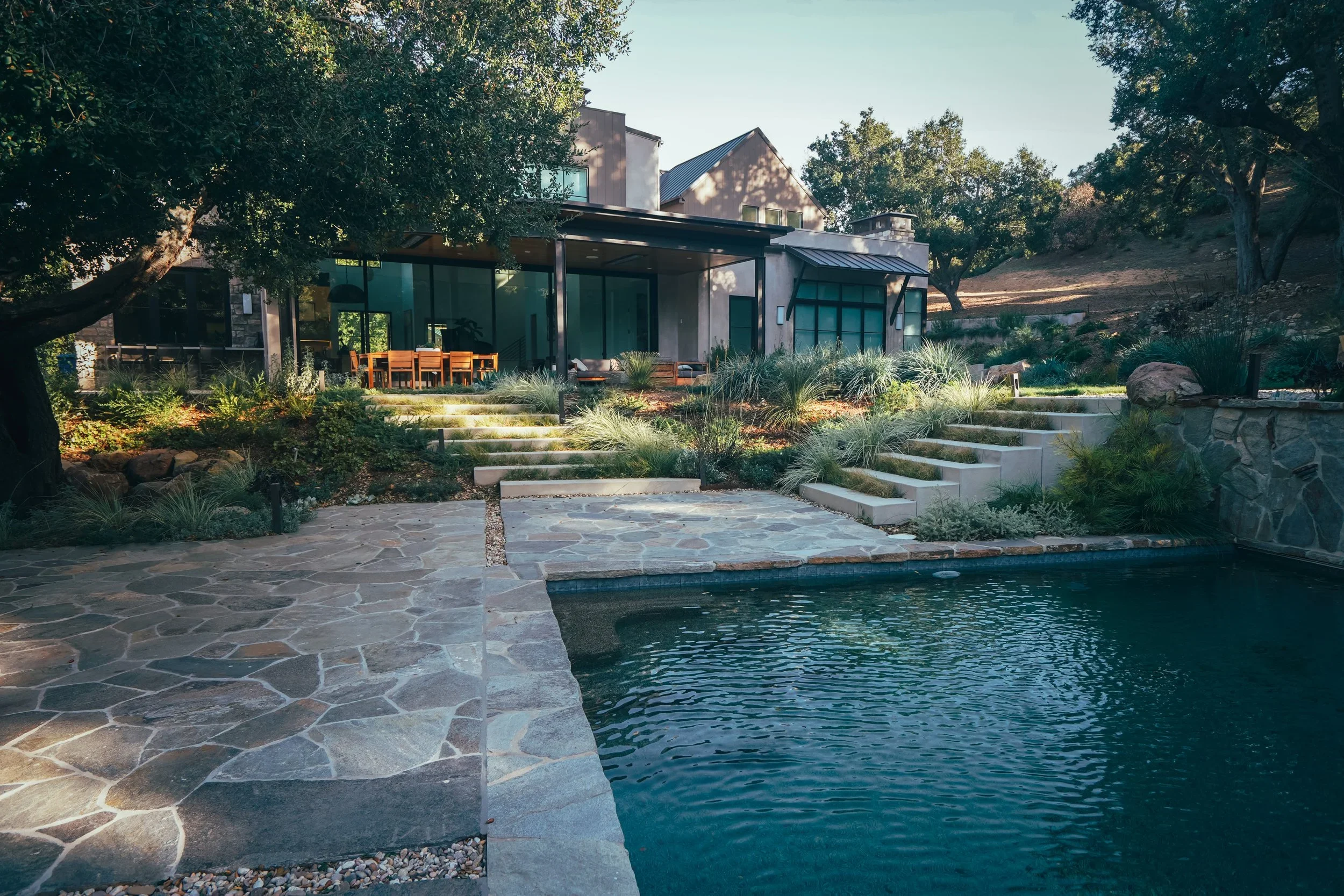
Firescaping & Flood-Resilient Landscape Design
Practical tips and plant recommendations for creating a more fire-resilient landscape.

A Guide to Fire Resiliency
Fire-resilient landscapes can be practical, beautiful, and full of life. This guide brings together key firescaping principles, Zone Zero guidance, practical design tips, and plant recommendations by category to help support safer, more adaptable gardens.
Fire and flood are one story. Every plant choice must answer both — slowing water on hillsides, resisting ignition, and calling back the pollinators and birds that make a landscape truly alive.

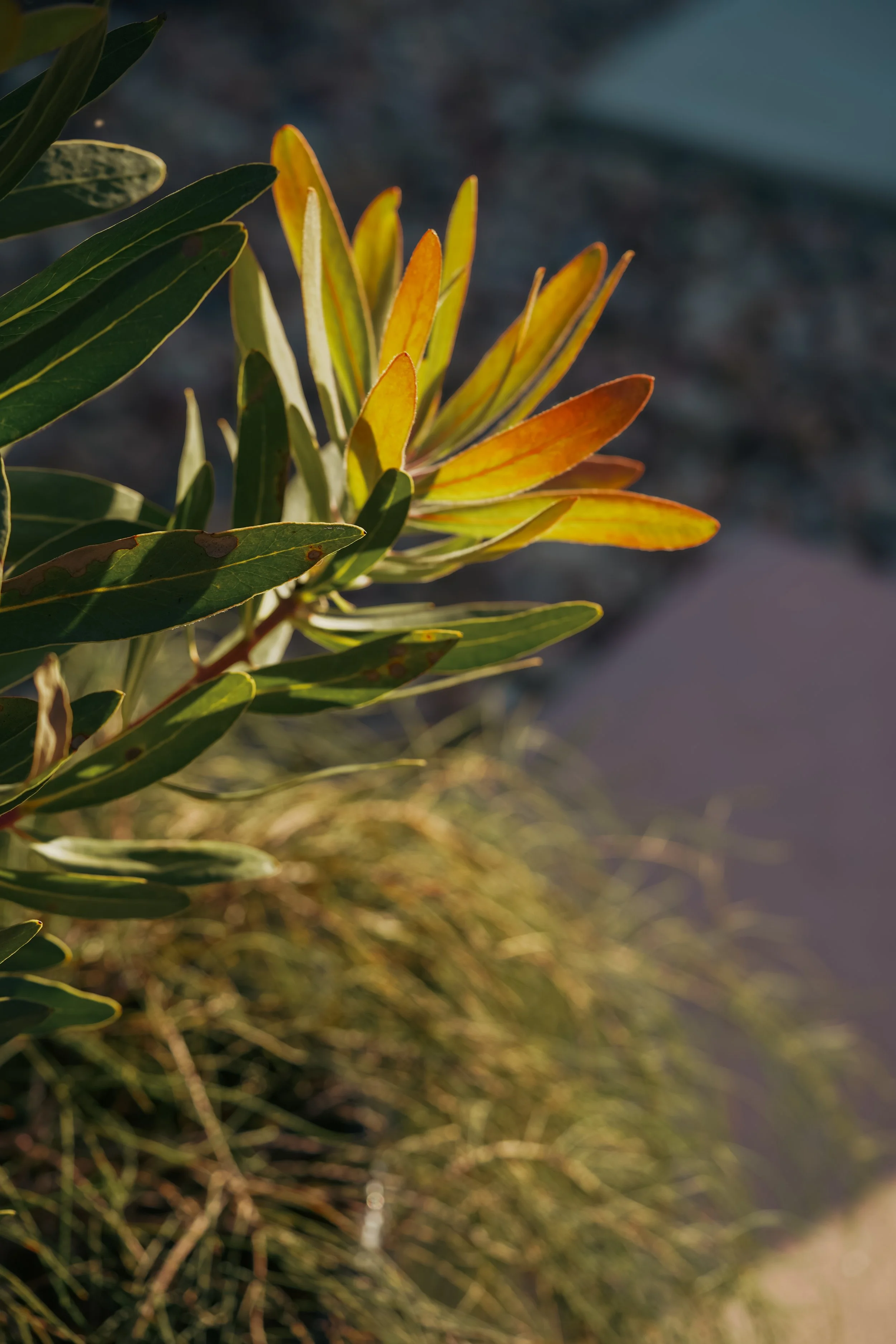
California's landscapes have always moved through cycles of fire, heat, wind, and heavy rain — and the plants, birds, pollinators, and animals that belong here have evolved with all of it. This ecological rhythm is part of what makes California so extraordinary. As we rebuild, the wisest path is to follow what that ecology already knows: plant what belongs, place it where it belongs. Rebuilding with natives and well-chosen adapted plants means working with a system that has been perfecting its resilience for thousands of years — a system organized, at its deepest level, around the oaks. Every planting choice we make is an opportunity to participate in that intelligence, and to find our own rightful place within it.

“Everything is in service to the trees — to the oaks.
The shrubs, the grasses, the pollinators, the birds: they are all part of one conversation, one long collaboration that California has been refining since long before we arrived.”

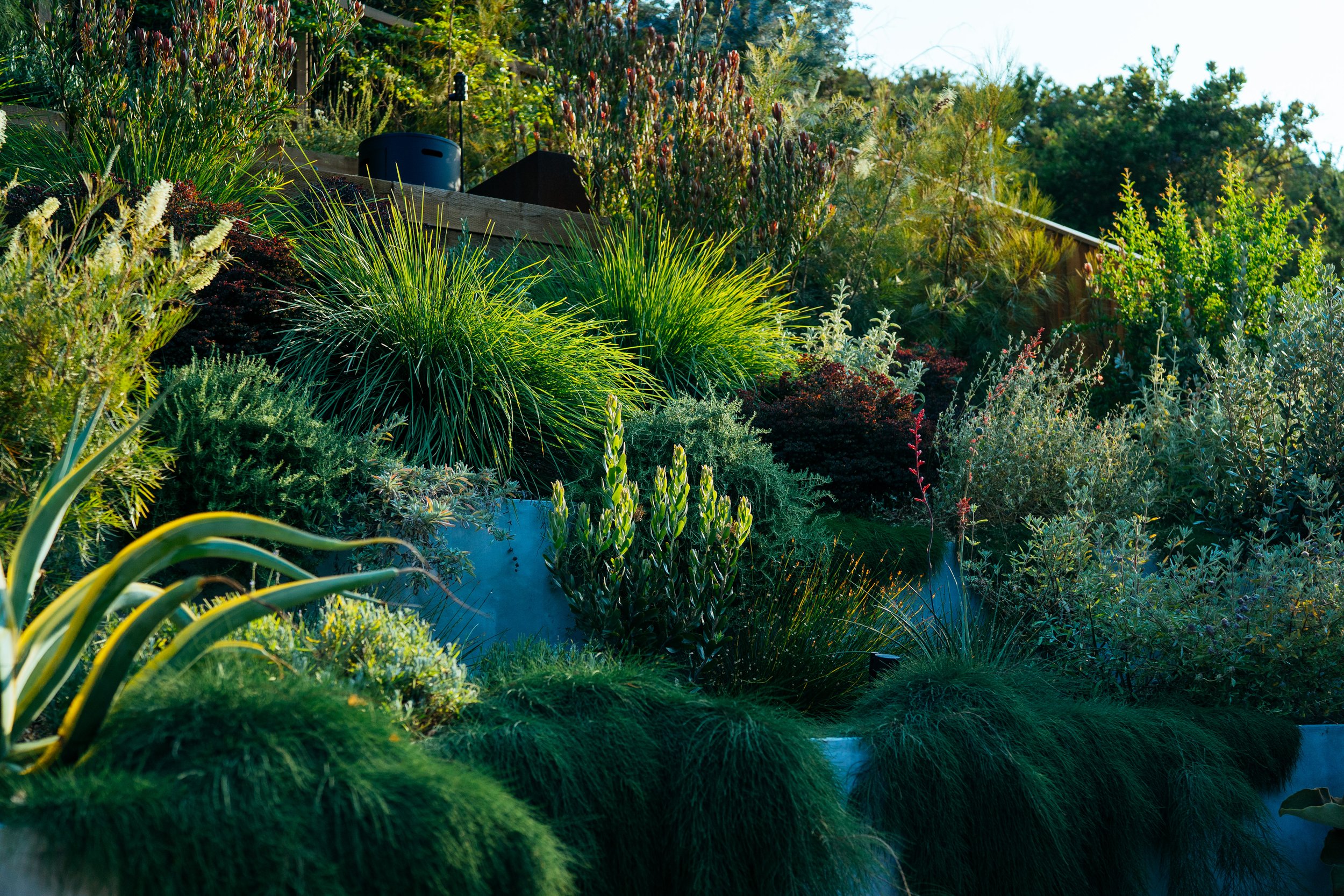

Tips for post-fire landscaping in LA
01
Design fire and flood as one system
The rains that follow fire are often more destructive than the fire itself. Every plant placement decision should slow water, reduce erosion, and reduce fuel load simultaneously.
02
Use zone zero as your first defense
Within 5 feet of structures, choose succulents, high-moisture natives, and hardscaping. Zone zero plants have high water content and minimal dead fuel accumulation.
03
Layer deeply on hillsides
Woody deep-rooted natives anchor slopes. Groundcovers and grasses catch water at the surface. Deep-rooted shrubs slow subsurface flow. Layer all three to truly stabilize a hillside.
04
Space and prune for fire behavior
Even fire-resistant plants become fire ladders when overcrowded or unpruned. Maintain vertical separation between ground fuels and tree canopies. Remove dead wood seasonally.
05
Plant for speed of recovery
California native plants evolved with fire. Many resprout from burls or root crowns after burning. Prioritize resprouters in zones where fire will return — they restore themselves.
06
Invite pollinators & birds from day 1
Recovery ecology depends on animal partnerships. Plant early-blooming natives immediately — they attract the insects that break soil compaction, distribute seeds, and accelerate ecosystem return.
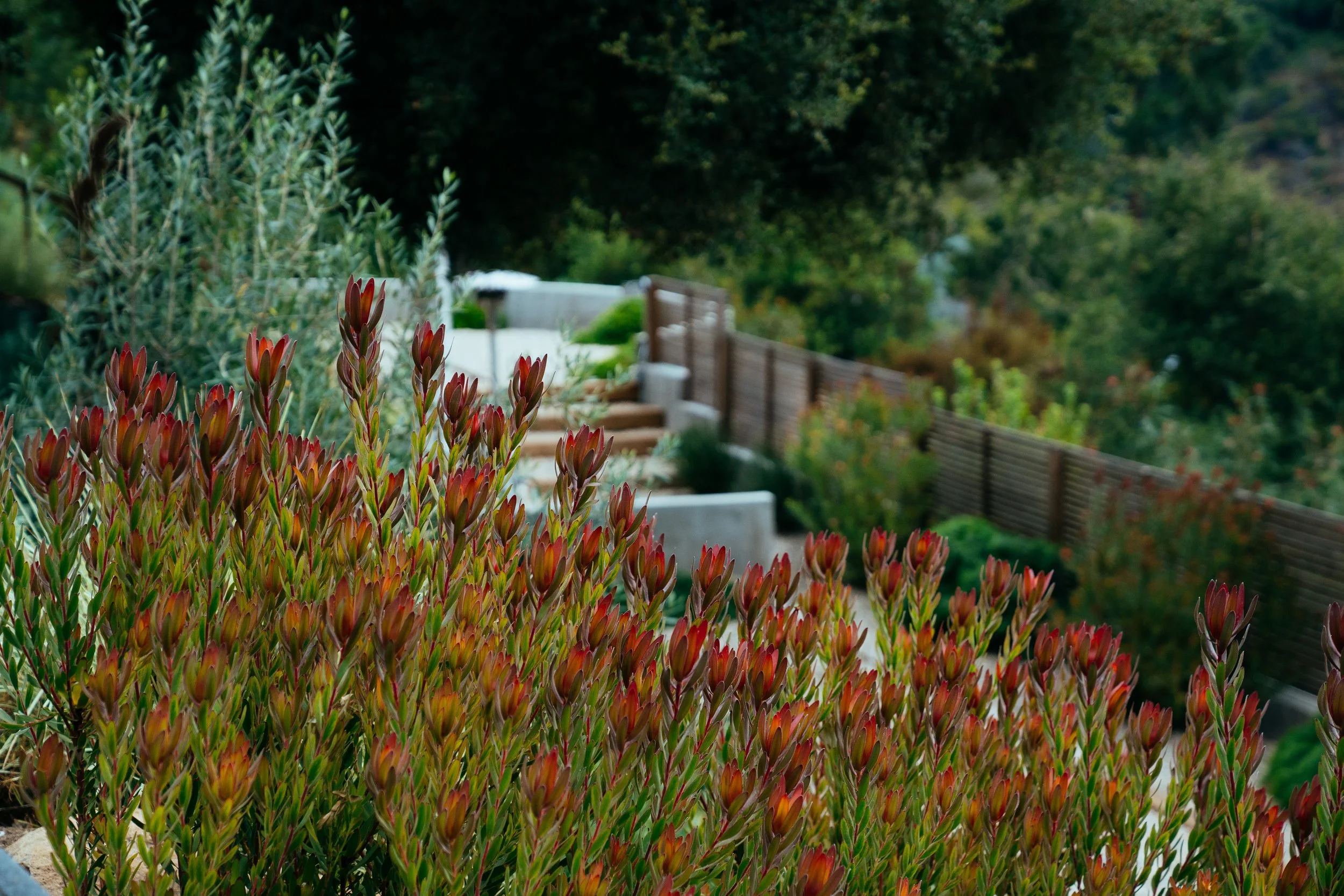
Resiliency in Plants
A guide to resilient plant choices for defensible space, changing climate conditions, slope stability, and habitat support.
-
Fire resilience starts closest to the home. Zone Zero refers to the immediate area around structures, where careful material choices, spacing, maintenance, and plant selection can help reduce risk.
Succulents & high-moisture plants
Within 5 feet of any structure — high water-content plants that resist ignition, require little to no irrigation once established, and provide ground-level habitat.
-
From fire-resistant to fire-adapted
Not all fire-tolerant plants work the same way. Some are genuinely low-flammability — thick bark, waxy or moisture-rich leaves, minimal volatile oils — and belong closest to structures. Others are fire-adapted: they carry aromatic oils, but have co-evolved with California's fire cycles and resprout powerfully from root crowns after burning. Both have essential roles in a resilient landscape.
-
Plants that hold the ground & slow the water
After fire, the first heavy rains can cause catastrophic erosion and debris flows. These plants establish quickly, hold slopes, and absorb or slow surface water — addressing fire and flood as the single system they are.
-
Anchoring slopes from crown to toe
Hillsides require a layered strategy: woody deep-rooted shrubs at the crown to slow subsurface water; fibrous-rooted grasses and groundcovers to catch surface flow; and surface absorbers at drainage transitions. Coyote brush and manzanita are the unsung heroes of this system — do not underestimate them.
Upper & mid slope — deep woody roots, habitat structure
-
Plants built for the hardest conditions
Los Angeles's climate is intensifying — more extreme heat events, stronger Santa Ana winds, longer dry seasons. These plants thrive without supplemental water once established, and many provide critical pollinator and bird habitat through the driest months.
-
Flowers are not static. They are in constant evolutionary conversation with the creatures that visit them — adapting their color, form, scent, and timing in response to who is coming, and when. Some have learned to self-pollinate as a form of insurance when pollinators are scarce. This is adaptation in real time, and it is one of the most extraordinary things happening in the California landscape right now, as climate shifts the rhythms that both plants and animals have relied upon for millennia.
The pollinators — bees, hummingbirds, butterflies, moths — are spectacular and visible. But they exist because the plant community created the conditions for them. And all of it: the salvias, the buckwheats, the manzanitas, the birds, the bees, is ultimately in service to the oaks. The oaks are the long memory of this landscape. When we plant for pollinators, we are planting for the whole system — and the oaks are always the goal.
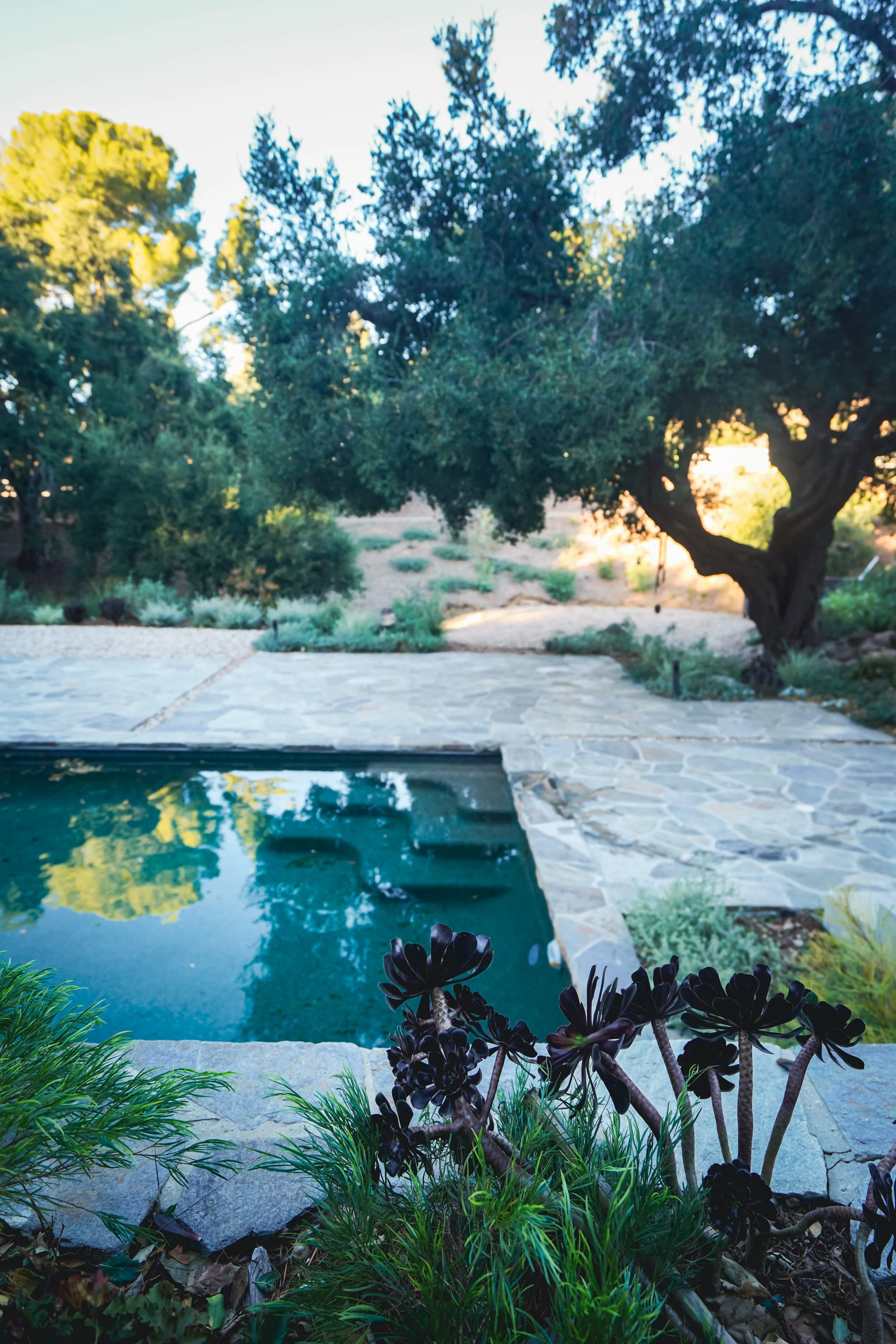

Recommendations for Fire, Draught & Flood Resistant Plants
Use the categories below to explore plants suited for fire resilience, erosion control, hillsides, drought, heat, wind, and more
-
Coast Live Oak
Category: Fire tolerant
Native, Tree, Bird HabitatQuercus agrifolia
The ultimate California fire-survivor. Thick corky bark insulates the cambium from heat. High leaf moisture content resists ignition. Resprouts from the base after even severe fire. The ecological anchor of the entire California landscape — plant oaks wherever you can.
-
Dudleya (Live-Forever)
Category: Zone zero
Native, Pollinator
Dudleya spp.
California native succulent with extraordinary fire resistance and high moisture content. Hummingbird magnet. Several species for various exposures — a true zone zero cornerstone.
-
Hen-and-chicks
Category: Zone zero
Fire-resistant, Pollinator
Echeveria spp.
Dense rosette form reduces fuel load to near zero. Striking blooms attract hummingbirds in late winter. Excellent massed at the base of walls and fences.
-
Agave
Category: Zone zero
Fire-resistant, Bird habitat
Agave spp.
Dramatic structural plants with near-zero flammability. Use A. attenuata near paths. Bloom stalks are critical habitat for orioles and bats.
-
Aloe
Category: Zone zero
Fire-resistant, Bird habitat, Pollinator
Aloe spp.
Winter-blooming aloes bridge the nectar gap for hummingbirds. Very high water content. A. vera and tree aloes provide structure while A. maculata carpets ground level.
-
Kalanchoe
Category: Zone zero
Fire-resistant, Pollinator
Kalanchoe blossfeldiana / thyrsiflora
Exceptionally high water content makes kalanchoe one of the best fire-resistant succulents for zone zero. Long-blooming clusters attract bees. Non-invasive, available from low groundcover to sculptural paddle plant forms.
-
Stonecrop
Category: Zone zero
Fire-resistant, Pollinator
Sedum spp.
Low-growing succulents that carpet the ground and attract beneficial insects. Excellent filler between pavers and at building edges. Low dead fuel accumulation.
-
Manzanita
Category: Fire tolerant, Hillside, Pollinator plants
Native, Fire-resistant, Pollinator
Arctostaphylos spp.
Among the most fire-resistant shrubs in the chaparral. Smooth dense wood with low resin content and high moisture-retaining capacity.
Many species resprout from a woody burl at the base after fire — one of the most remarkable survival strategies in the plant world.
Groundcover forms (A. uva-ursi, A. edmundsii) are exceptional for mid-slope stabilization — dense, low, and wide-spreading with a deep root network.
Early-season blooms critical for queen bumblebees emerging in late winter.
Early-winter blooms are among the first nectar sources of the year — critical for queen bumblebees emerging from dormancy.
Berries feed mockingbirds, thrashers, and many other species.
Among the most ecologically valuable plants in California.
-
Ceanothus (Wild Lilac)
Category: Fire tolerant, Hillside
Native, Fire-resistant, Pollinator
Ceanothus spp.
Waxy moisture-retaining leaves give Ceanothus genuinely low flammability relative to its chaparral neighbors. Nitrogen-fixing roots rebuild depleted post-fire soils.
Some species resprout; others require fire to break seed dormancy — a profound ecological partnership with fire.
Sprawling groundcover forms (C. griseus horizontalis, C. gloriosus) hold slopes beautifully while nitrogen-fixing roots improve soil. Spectacular spring bloom. Some species resprout after fire; others rely on fire to break seed dormancy.
-
Flannel Bush
Category: Fire tolerant
Native, Fire-resistant, Pollinator
Fremontodendron californicum
Spectacular golden-yellow blooms cover the plant in spring. Classified as fire-resistant in many CalFire guidelines — non-resinous with low volatile oil content. Extremely drought tolerant. Native bees swarm the flowers. Resprouts vigorously from the base after fire.
-
Lemonade Berry
Category: Fire tolerant
Native, Fire-resistant, Pollinator
Rhus integrifolia
Dense waxy leaves with low volatile oil content make this one of the least flammable chaparral shrubs. Resprouts from root crown after fire. Use as a structural screen or slope cover in zones close to structures where fire resistance matters most.
-
Toyon (Christmas Berry)
Category: Fire tolerant, Hillside
Native, Fire-resistant, Bird habitat
Heteromeles arbutifolia
Thick leathery leaves with low flammability and high moisture content.
Resprouts vigorously after fire.
Critical winter berry source for cedar waxwings, mockingbirds, and robins.
One of the most ecologically valuable shrubs in the California landscape.
Deep woody roots anchor hillsides while providing year-round wildlife value.
Plant at mid-slope in groupings to create wildlife corridors and interrupt water velocity across the face of the slope.
-
White Sage
Category: Fire tolerant, Pollinator plants
Native, Pollinator, Bird habitat
Salvia apiana
Sacred and ecologically irreplaceable. Powerfully aromatic silver foliage.
One of the most important bee plants in Southern California.
Among the most important bee plants in Southern California. Bumble bees perform buzz pollination on the flowers — a specialized technique that releases pollen not accessible to other insects.
A critical seed source for birds.
Resprouts reliably after fire.
-
Purple Sage
Category: Fire tolerant, Hillside
Native, Pollinator
Salvia leucophylla
Stunning lavender-pink bloom in spring. Beloved by native bees and hummingbirds.
Forms dense mounds that resprout after fire and suppress weeds.
A hillside and slope essential.
Forms large mounding colonies on slopes — fragrant and structurally effective at slowing water velocity.
Use with buckwheats for a classic coastal sage scrub hillside palette.
-
Black Sage
Category: Fire tolerant
Native, Pollinator
Salvia mellifera
"Mellifera" means honey-bearing — among the most important bee plants in California. Summer-dormant and drought-hardy. Seeds feed birds through winter. Resprouts from root crown after fire.
-
Cleveland Sage
Category: Fire tolerant
Native, Pollinator
Salvia clevelandii
Intensely fragrant — thrives in heat and wind. Major nectar source for native bees and hummingbirds spring through summer. One of the most drought-tolerant salvias in Southern California.
-
California Sagebrush
Category: Fire tolerant, Hillside
Native, Pollinator, Bird habitat
Artemisia californica
The signature scent of coastal sage scrub. Fast-establishing with rapid root development. Resprouts after fire. Critical nesting material for bushtits and other small birds. Irreplaceable as a community anchor.
Plant away from structures — moderately flammable — but irreplaceable as a mid-slope anchor and key species for coastal sage scrub restoration.
-
California Buckwheat
Category: Fire tolerant, Hillside, Pollinator plants
Native, Pollinator, Bird habitat
Eriogonum fasciculatum
Perhaps the single most important plant for native bees in Southern California. White-to-rust blooms all summer. Extremely drought-hardy. Hosts many butterfly species. Reseeds on disturbed slopes after fire.
Woody base with fibrous root network — excellent mid-slope stabilizer. White-to-rust blooms through summer. Combines beautifully with salvias and sagebrush. Reseeds readily on disturbed slopes.
Host plant for the Acmon blue, Bramble hairstreak, and many other butterfly species. Rusty dried flower heads provide seeds for birds through winter. One of the most ecologically layered plants in the California palette.
-
Coastal Buckwheat
Category: Fire tolerant
Native, Pollinator
Eriogonum cinereum
Woolly gray foliage with soft pink flower clusters. Thrives in coastal and inland conditions alike. An excellent companion to the salvias in a coastal sage scrub palette. Bees adore it.
-
Coyote Brush
Category: Fire tolerant, Hillside
Native, Pollinator, Fire-resistant
Baccharis pilularis
One of the fastest-establishing natives in California. Resprouts after fire.
Supports over 130 insect species — a keystone plant for the entire food web.
Equally important for erosion control and hillside planting.
The single most important shrub for hillside stabilization in coastal California. Establishes faster than almost any other native. Woody root system anchors deeply. Supports 130+ insect species. Resprouts after fire. Plant generously.
-
Coffeeberry
Category: Fire tolerant
Native, Pollinator, Bird habitat
Frangula californica
High leaf moisture content and low flammability. Resprouts reliably after fire. Berries feed over 30 species of birds. Tolerates deep shade to full sun — an excellent oak woodland understory companion.
-
Hollyleaf Redberry
Category: Fire tolerant
Native, Bird habitat
Rhamnus ilicifolia
Tough spiny-leaved shrub of the chaparral-woodland interface. Resprouts after fire. Red berries feed thrashers, mockingbirds, and many other birds. Deer resistant and very drought tolerant once established.
-
Island Bush Snapdragon
Category: Fire tolerant
Native, Pollinator
Galvezia speciosa
Long-blooming red flowers critical for hummingbirds. Lower volatile oil content than many chaparral shrubs. Beautiful cascading form on slopes and retaining walls.
-
Oregon Grape
Category: Fire tolerant
Native, Pollinator, Bird habitat
Mahonia aquifolium
Leathery holly-like leaves with good fire resistance. Early yellow blooms are a critical nectar source. Dark berries feed many bird species. Thrives in dry shade beneath oaks — an excellent woodland understory plant.
-
Blue Rush
Category: Erosion & flood, Hillside
Native, Erosion, Bird Habitat
Juncus patens
A surface-level sponge — dense fibrous roots absorb and hold water at the soil surface before it can run. Essential for bioswales, drainage corridors, and the base of slopes. Seeds attract finches.
Plant in mass at the toe of slopes to act as a living sponge — absorbing and slowing surface water before it exits the property or enters storm drains. Essential at swales and drainage transitions.
-
Clustered Field Sedge
Category: Erosion & flood
Native, Erosion
Carex praegracilis
A versatile native sedge for moist to seasonally dry conditions. Dense fibrous root mat stabilizes topsoil quickly. Works beautifully as a lawn alternative or alongside Juncus in drainage swales.
-
California Fescue
Category: Erosion & flood
Native, Erosion, Pollinator
Festuca californica
Deep-rooted native grass that rapidly colonizes bare slopes after fire. Airy elegant structure. Dramatically reduces erosion during first post-fire rains. Host plant for several native butterflies.
-
Deer Grass
Category: Erosion & flood, Hillside
Native, Erosion, Bird habitat
Muhlenbergia rigens
California's most versatile native grass for erosion control. Massive fibrous root system holds heavy clay soils.
Striking burgundy seed stalks provide bird food through winter. Resprouts after fire.
Massive fibrous root system catches water at the slope base. Beautiful structure year-round. Plant in sweeps at drainage transitions and low points where water collects after rain.
-
Giant Wild Rye
Category: Erosion & flood
Native, Erosion, Bird habitat
Leymus condensatus
Dramatic large-scale native grass for banks and disturbed slopes. Spreads by rhizome to quickly bind bare ground. Seeds are an important food source for sparrows and other seed-eating birds.
-
California Wild Strawberry
Category: Erosion & flood, Hillside
Native, Erosion, Pollinator
Fragaria californica
Rapid-spreading groundcover with stolons that bind topsoil quickly. One of the first plants to return post-fire. Flowers attract native bees. Fruit eaten by birds and small mammals.
Low spreading groundcover that knits the soil surface together quickly. Use at the base of slopes and in shaded transition zones. One of the first plants to return on its own after fire.
-
Yarrow
Category: Erosion & flood, Hillside, Pollinator plants
Native, Erosion, Pollinator
Achillea millefolium
A remarkable multi-tasker — fibrous roots stabilize bare soil, flat-topped flower clusters feed an enormous range of beneficial insects, and feathery foliage suppresses weeds.
Flat-topped flower clusters are landing pads for an enormous range of beneficial insects — native bees, parasitic wasps, hoverflies, and butterflies all use it.
Blooms over a long season.
Spreads by rhizome to bind topsoil on gentle slopes.
Excellent companion to salvias and grasses in a mid-slope mix.
Site thoughtfully in deeply hot exposed locations where establishment can be challenging. Site in areas with some afternoon shade in hot inland locations for best establishment.
-
Saltgrass
Category: Erosion & flood
Native, Erosion
Distichlis spicata
Extremely tough native grass for difficult sites — heavy clay, alkaline soils, seasonal flooding. Dense rhizome network holds eroding banks through both flood and drought extremes.
-
Foothill Penstemon
Category: Hillside
Native, Pollinator
Penstemon heterophyllus
Establishes on rocky hillsides where little else grows. Taproot and fibrous roots stabilize thin soils. Brilliant blue-violet flowers bring bees and hummingbirds. Reseeds readily on disturbed slopes.
-
Palo Verde
Category: Drought heat & wind
Pollinator, Bird habitat
Parkinsonia florida / aculeata
Photosynthesize through bark — survives severe drought by shedding leaves entirely. Spectacular yellow bloom. Open canopy ideal for wind protection without creating a fuel ladder. Attracts native bees, verdin, and cactus wrens.
-
Woolly Blue Curls
Category: Drought heat & wind
Native, Pollinator
Trichostema lanatum
A chaparral specialist that revels in heat, wind, and extreme drought. Spectacular purple-blue flowers with woolly bracts. One of the most attractive plants to bumble bees in its range. Never overwater.
-
Chaparral Bush Mallow
Category: Drought heat & wind
Native, Pollinator, Bird habitat
Malacothamnus fasciculatus
Tall airy shrub with soft pink blooms beloved by native bees. Extremely drought tolerant once established. Fast growing — useful as a temporary windbreak while slower-growing plants establish.
-
Canyon Sunflower
Category: Drought heat & wind
Native, Pollinator
Venegasia carpesioides
Bright yellow blooms in dry shade beneath oaks and sycamores — a rare native that thrives where few others will. Cheerful and resilient. Beloved by native bees and butterflies.
-
Deerweed
Category: Drought heat & wind, Pollinator plants
Native, Pollinator, Erosion
Acmispon glaber
A pioneer that colonizes bare disturbed soil and fixes nitrogen — actively restoring fertility to depleted post-fire ground.
Critical larval host for several native butterfly species.
Fast-growing and drought-hardy.
Larval host for the Silver-spotted skipper and several other native butterfly species. Nitrogen-fixing pioneer that improves post-fire soils while hosting the next generation of pollinators simultaneously.
-
Blue-eyed Grass
Category: Drought heat & wind
Native, Pollinator
Sisyrinchium bellum
Tiny perennial with blue-violet flowers and grass-like foliage. Lower dead fuel accumulation than ornamental grasses. Native bees love it. Use massed in perennial borders or woven between shrubs.
-
California Fuchsia
Category: Pollinator plants
Native, Pollinator
Epilobium canum
Blazing orange-red tubular flowers in late summer and fall — exactly when hummingbirds need fuel most. Spreads by rhizome to cover bare ground. One of the most reliable late-season nectar plants in the California palette.
-
Scarlet Bugler
Category: Pollinator plants
Native, Pollinator
Penstemon centranthifolius
Tall spikes of brilliant red tubular flowers engineered for hummingbirds. Dramatic on dry slopes. Reseeds readily after fire — often one of the first showy natives to return.
-
Fuchsia-flowered Gooseberry
Category: Pollinator plants
Native, Pollinator, Bird habitat
Ribes speciosum
Winter-blooming dangling red flowers are a critical early-season hummingbird resource. Thorny structure provides excellent nesting cover for birds. A beloved plant in the California native garden tradition.
-
Hummingbird Sage
Category: Pollinator plants
Native, Pollinator
Salvia spathacea
Large magenta flowers on tall spikes irresistible to hummingbirds. Spreads by rhizome in shade and semi-shade. Thrives under oaks — a beautiful choice for the woodland garden.
-
Grevillea
Category: Pollinator plants
Native, Pollinator, Well-adapted
Grevillea spp.
Australian natives deeply compatible with Southern California's climate. Extraordinary hummingbird magnets — tubular flowers rich with nectar year-round. Non-invasive and long-lived. Many species for varying scale and exposure.
-
Leucospermum (Pincushion)
Category: Pollinator plants
Pollinator, Well-adapted
Leucospermum spp.
South African protea family plants that thrive in our Mediterranean climate. Spectacular pincushion blooms are exceptional hummingbird and native bee resources. Long blooming, drought tolerant once established. Non-invasive.
-
Leucadendron
Category: Pollinator plants
Bird habitat, Well-adapted
Leucadendron spp.
From South Africa's fynbos — which shares striking climate similarities with California. Colorful bracts provide year-round interest and excellent habitat structure. Non-invasive and extremely drought tolerant.
-
Chia
Category: Pollinator plants
Native, Pollinator, Bird habitat
Salvia columbariae
California's native chia — intense blue-purple flowers beloved by native bees. Seeds are a critical food source for birds and were a staple of indigenous Californians. Reseeds freely on disturbed ground.
-
California Goldenrod
Category: Pollinator plants
Native, Pollinator, Bird habitat
Solidago californica
Late-season bloomer that feeds the last bees of the year. Critical resource for migrating monarch butterflies. Seeds feed goldfinches and sparrows. Spreads gently by rhizome to fill bare areas.
-
Purple Nightshade
Category: Pollinator plants
Native, Pollinator
Solanum xanti
Native bumble bees buzz-pollinate these violet flowers — releasing pollen unavailable to other insects. Beautiful and underused. Thrives in part shade at the edges of oak woodland.
-
Cobwebby Thistle
Category: Pollinator plants
Native, Pollinator, Bird habitat
Cirsium occidentale
A striking native thistle — not a weed. Dramatic silver-white stems and vivid magenta blooms. Goldfinches nest in the down and eat the seeds. Bumble bees and painted lady butterflies depend on it.
-
California Aster
Category: Pollinator plants
Native, Pollinator
Symphyotrichum californicum
Late-season lavender daisy beloved by migrating butterflies and native bees. Host plant for several checkerspot butterfly species. Spreads gently in moist areas and at the edges of drainage swales.
Ready to rebuild with resilience?
Viola Gardens designs and builds ecologically-grounded post-fire landscapes — from site assessment and plant selection through full installation. Every project is designed with fire, flood, drought, and habitat restoration as a unified system.